Master your mind. Elevate your business. Why self-leadership is becoming the most critical leadership capability.
2026
Only 30% That is what McKinsey's research consistently finds when asking organisations whether their transformation initiatives achieve meaningful results, despite nearly 80% of those same organisations rating transformation as critically important to their future. The gap is striking. Strategies are sound, technologies are capable, and budgets are committed. So why do so many efforts fall short? The answer, in most cases, is not found in spreadsheets or market analyses. It is found in the behaviour of leaders, specifically, in their capacity to lead themselves before they attempt to lead anyone else.
The most powerful change in any organisation always begins in the same place: within the leader. This article is written for leaders who carry genuine responsibility, those running business units, managing teams through change, or steering organisations through conditions that shift faster than any strategy document anticipated. If that is you, the ideas here are not abstract. They are practical, and they are urgent.
Leadership Under Pressure: What Is Actually Being Tested. Consider two leaders facing the same situation. A key market has softened unexpectedly, a product launch has underperformed, and the board wants answers within the week. One leader retreat into over-analysis, becomes short-tempered with colleagues, and oscillates between denial and catastrophising. The other convenes the right people, asks focused questions, and begins working the problem with methodical clarity. Same circumstances. Fundamentally different responses.
The difference is rarely intelligence, sector experience, or access to better information. It is mindset, specifically, the capacity to remain constructive, curious, and solutions-oriented when circumstances push in the opposite direction. As business conditions have grown more complex over the past decade, more competitive, more digitally disrupted, more geopolitically uncertain, this distinction has moved from a nice-to-have to a defining leadership characteristic. Technical expertise remains essential. But it has become the floor, not the ceiling. What separates effective leaders today is how they think and behave under pressure, not merely what they know.
The leaders who navigate uncertainty best tend to share a particular habit of thought. Rather than asking "Why is this happening to us?", they ask "What can we do differently?" That shift, from attribution to agency is not trivial. It redirects cognitive and emotional energy from a problem that cannot be changed to a response that can be shaped. And in a leadership role, that redirection has a multiplier effect on everyone around you.
Self-Leadership: What It Actually Means. Self-leadership is one of those terms that invites scepticism, and reasonably so. It is often conflated with productivity hacks, morning routines, or most dismissively mindfulness dressed up in corporate language. That conflation misses the point. Self-leadership, properly understood, is not about optimising your calendar or meditating before board meetings. It is about taking deliberate ownership of the internal factors that determine your effectiveness as a leader. Specifically, three of them:
Thinking: The way you interpret a situation shapes every decision that follows. Two leaders given identical data will frame it differently, notice different implications, and arrive at different conclusions, not because one is smarter, but because their mental models differ. Leaders who develop awareness of their own interpretive habits can interrogate those habits rather than simply act on them. That capacity for self-scrutiny is a genuine competitive advantage.
Behaviour: Leadership credibility is not proclaimed; it is accumulated through behaviour, and it is most visibly tested under pressure. How you communicate when a project fails. How you respond when you disagree with a decision from above. How you treat a junior colleague when you are under time pressure. These moments, repeated across months and years, define the culture around you and the level of trust you command.
Energy: Leadership is psychologically demanding work. Strategies fail, relationships require constant maintenance, and the pace of change does not allow for recovery time the way previous generations of leaders might have expected. Resilient leaders, those who recover quickly from setbacks, maintain their standards under strain, and continue thinking clearly when conditions deteriorate are not simply born that way. They have typically developed deliberate practices that protect and restore their capacity to function well.
The distinction is clear: self-leadership is not about controlling everything around you. It is about maintaining meaningful influence over how you respond to what you cannot control. That is an entirely different and considerably more achievable proposition. The gap between knowing what needs to change and actually changing it is rarely a strategy problem. Organisations understand the destination. What stops them is human.
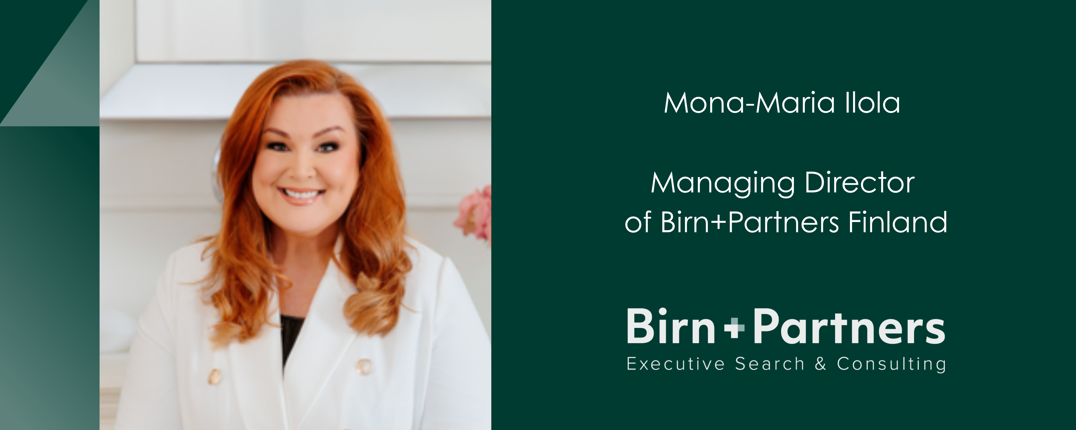
Mona-Maria Ilola
Managing Director, Birn+Partners Finland
Transformation asks people to abandon habits that have served them well, to acquire skills that may feel awkward, and most uncomfortably for leaders who have built careers on a particular set of competencies to rethink professional identities that feel hard-won. A senior executive who has spent two decades succeeding through hierarchical decision-making does not find it straightforward to operate in a flatter, more collaborative structure, even when they intellectually endorse the change.
This is not weakness. It is neurology. Established patterns of thinking and behaviour are genuinely difficult to shift, and the difficulty increases with seniority because the patterns are more deeply reinforced.Organisations that manage transformation effectively tend to share one observable characteristic - their senior leaders visibly model the change they are asking for. They adapt their own behaviour first, acknowledge publicly when they find it difficult, and demonstrate that the discomfort of change is navigable. That modelling has an outsized effect on organisational culture that no communication campaign can replicate.
Transformation is not only an organisational initiative. At its heart, it is a personal decision and it must begin with the people leading it.
The Neuroscience: What It Means in Practice. The scientific basis for why mindset matters in leadership is now well established, and it points to something genuinely useful rather than merely reassuring. Our brains reinforce neural pathways based on repetition. Thought patterns that are activated frequently become stronger and, over time, automatic. A leader who habitually interprets setbacks as threats will, neurologically, become increasingly predisposed to that interpretation, not because they choose to, but because the pathway has been well-worn. The same mechanism operates in the opposite direction: consistent focus on solutions, learning, and constructive action strengthens the neural pathways associated with those orientations.What this means practically is that mindset is not fixed. It is a set of patterns that can be shaped through deliberate practice. Leaders who build habits of reflection, reviewing decisions not just for outcomes but for the thinking behind them, gradually develop a more accurate and flexible view of their own mental patterns. That accuracy is what makes adjustment possible.
A related and increasingly well-documented challenge is decision fatigue. Modern leaders make a far greater volume of decisions than previous generations, driven by the demands of digital communication, flatter structures, and faster cycles. Research suggests cognitive resources deplete as decisions accumulate, meaning that the quality of judgment available at 4pm on a demanding Thursday is meaningfully different from the quality available at 9am on a clear Monday. Practices such as protecting blocks of uninterrupted thinking time, delegating decisions that do not require senior judgment, and building recovery into the working week are not indulgences. They are rational responses to how cognition actually works.
The Growth Loop: How Development Actually Happens. There is a persistent myth that significant leadership development requires significant events a major setback, a transformational coaching programme, a career-defining crisis. The evidence points in a different direction.Meaningful leadership growth tends to begin not with dramatic change but with honest awareness. Leaders who develop the habit of examining their own thinking not harshly, but accurately, gain the ability to make small adjustments to their behaviour. Those adjustments, compounded over time, produce better outcomes. Better outcomes build confidence. Confidence makes it easier to sustain constructive behaviour even under pressure. And that cycle, repeated consistently, produces development that is both deep and durable. Think of a leader who begins noticing that they consistently interrupt colleagues in meetings. Not because they are arrogant, but because they process quickly and become impatient when conversation moves slowly. Naming that pattern is the first step. Experimenting with holding back asking one more question before contributing is the second. The impact on team dynamics, over months, can be substantial. And the change began with a moment of noticing.This is what the growth loop looks like in practice. Not a transformation, but an accumulation.
Calmness as a Strategic Capability. One leadership quality has become disproportionately valuable in conditions of sustained uncertainty, and it is consistently underestimated: the capacity to remain calm under pressure. Not the performance of calmness forced affability or managed cheerfulness but genuine psychological steadiness. The ability to listen carefully when the instinct is to react. To hold a difficult conversation without either aggression or avoidance. To make a decision under uncertainty without either paralysis or false confidence.These qualities appear understated because they are quiet. They do not show up in a keynote address or a bold strategic announcement. They show up in a one-to-one conversation at a moment of organisational stress, when a team member is uncertain and needs a leader who can think clearly rather than simply project conviction.In organisations navigating genuine complexity and most organisations are - this kind of leadership is rare and disproportionately valuable. It creates the psychological safety that allows teams to surface problems early, think creatively, and move with confidence through ambiguity. It is not soft. It is strategic.
Leading Yourself First. The practical implication of everything above is simple, though not easy: before leaders can effectively transform their organisations, they must be genuinely willing to transform themselves. This requires a particular kind of resilience not the optimism that insists everything will work out, but the discipline to remain constructive when circumstances are difficult, to maintain standards under strain, and to keep learning when the environment shifts in ways that make existing approaches insufficient. Start with one honest question. Not "Am I a good leader?" that question is too broad to be useful. But "What is one pattern in my thinking or behaviour that, if I changed it, would make me more effective?" Then examine that pattern with genuine curiosity rather than self-criticism. Identify one small change. Make it consistently for thirty days. Review what you notice.Markets will continue to shift. Technologies will continue to reshape competitive landscapes. Organisations will be called upon to adapt, repeatedly, and at speed. None of that will change.What can change is the quality of the leader meeting those conditions. And that change, like most meaningful change, begins not with a strategy but with a decision.
References
Baumeister, R.F. & Tierney, J. (2011). Willpower: Rediscovering the Greatest Human Strength. Penguin Press.
Doidge, N. (2007). The Brain That Changes Itself. Viking Press.
Goleman, D. & Davidson, R.J. (2017). The Science of Meditation. Penguin Life.
McKinsey & Company (2021). Losing from day one: Why even successful transformations fall short.